
The biggest problem with the AI bubble is you
The good news is that AI is poised to change every aspect of our lives, and that's the bad news, too. Can AI erotica win people over?


AI’s value proposition seems nearly limitless: business efficiency, scientific and technological advancements, problem solving, social connection, empowerment—the list goes on. So, it’s no wonder investors are on pace to pump nearly $1.5 trillion into the technology this year.
It will all pay off, of course, with widespread AI adoption. The problem is there’s not a lot of enthusiasm to welcome our new AI overlords. A Pew Research study found only 16% of people globally are more excited than concerned about the use of AI in daily life. And another 34% say they are more concerned.
In the U.S. the numbers are even more bleak for the industry: 50% say they’re concerned, and just 10% are excited. For AI evangelists, the skepticism domestically is a big problem. Few, if any, countries have adopted AI as much as the U.S. People are seeing AI change their work, make mistakes, and increase their electric bills. They are not happy.
People don’t see AI making their lives easier in the way the steam engine eased back-breaking labor, or the convenience and wonder exhibited by the early Internet. Among other things, they see it as a robot replacement at work, a dangerous relationship that isolates people, a resource-depleting threat to life, and an untrustworthy source of information. In short, people fear it’s gaining too much power and can’t be trusted. They’ve all seen The Terminator and know how it ends.
The leaders of the AI ‘revolution’ recognize the problem: AI isn’t delivering the goods fast enough. Businesses are disappointed. A Massachusetts Institute of Technology study published this fall found 95% of AI pilots fail. A Boston Consulting Group study found that 66% of executives are ambivalent or dissatisfied with AI projects at their companies.
Why the AI economy is running out of time
A lack of public and business enthusiasm is the biggest threat to AI investment. Data center building depends on public support, but a growing number of them are being blocked by local governments amid public outcry.
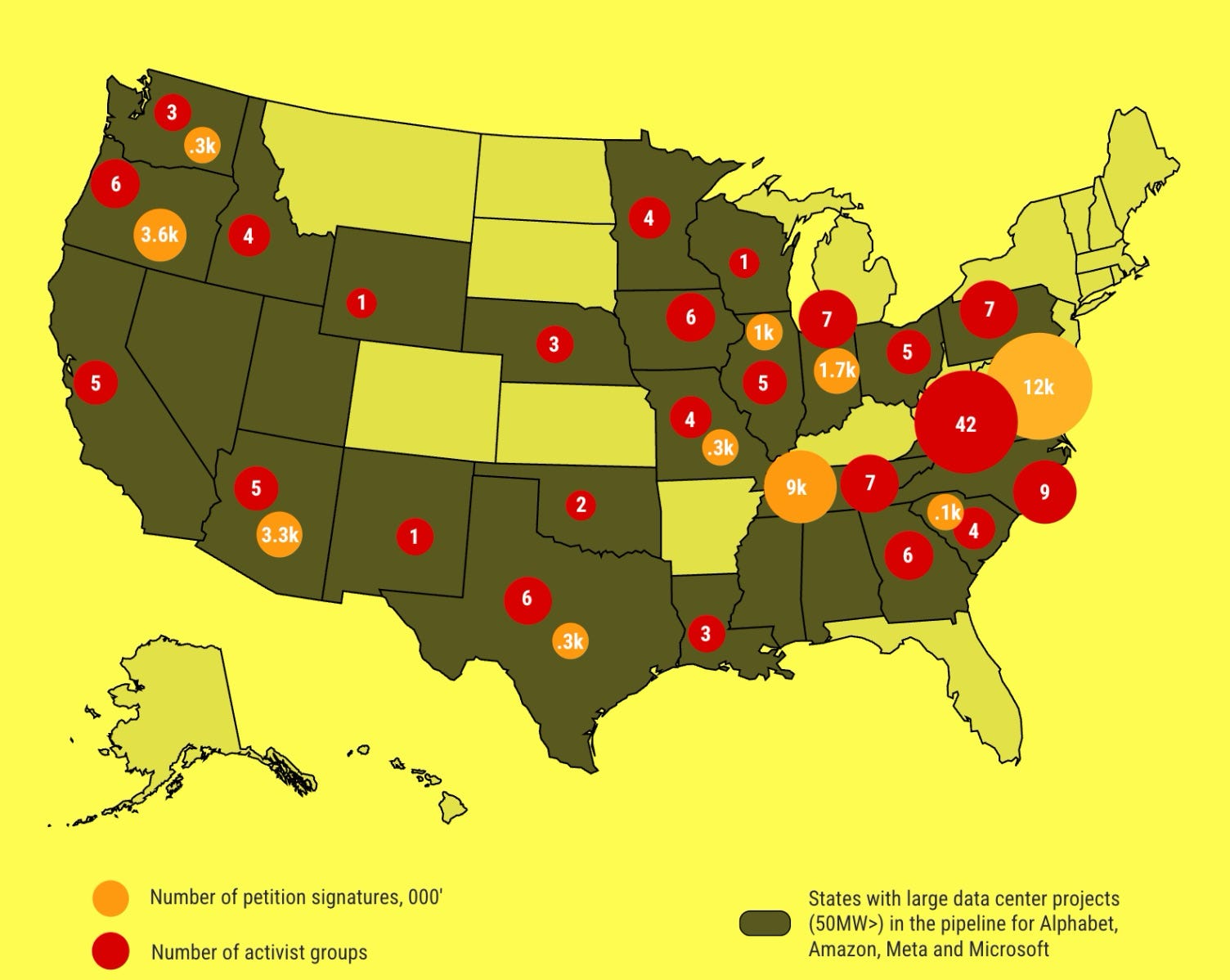
I asked ChatGPT “If the U.S. only builds 50% of the data centers the AI industry needs, what will happen to the industry (answer in 50 words or less)?” It responded:
“If the U.S. builds only half the needed data centers, AI growth will bottleneck—slower model training, higher costs, and greater dependence on foreign infrastructure. Innovation may shift overseas, weakening America’s AI competitiveness, straining energy grids elsewhere, and deepening geopolitical risks around compute and data sovereignty.”
I found this to be an alarming response—not because I’m worried about AI competitiveness in the U.S.—but because that response is fear-mongering propaganda. If we don’t build data centers it could be World War III!!! It’s exactly the reason people are scared of this industry.
We shouldn’t be surprised the people (and machine) behind AI are trying to scare us into building an AI ecosystem even though our energy bills may soar to $2,000 a month and we are substituting Red Bulls for water to stay alive.
Jensen Huang, Sam Altman, and Satya Nadella are under the gun to make this pay off faster. There are just 20 million paying users of OpenAI’s ChatGPT. And a new Deutsche Bank report shows the growth of paying users in Europe has stalled along with revenue. Remember: The Europeans are more enthusiastic about AI than we are, according to Pew.
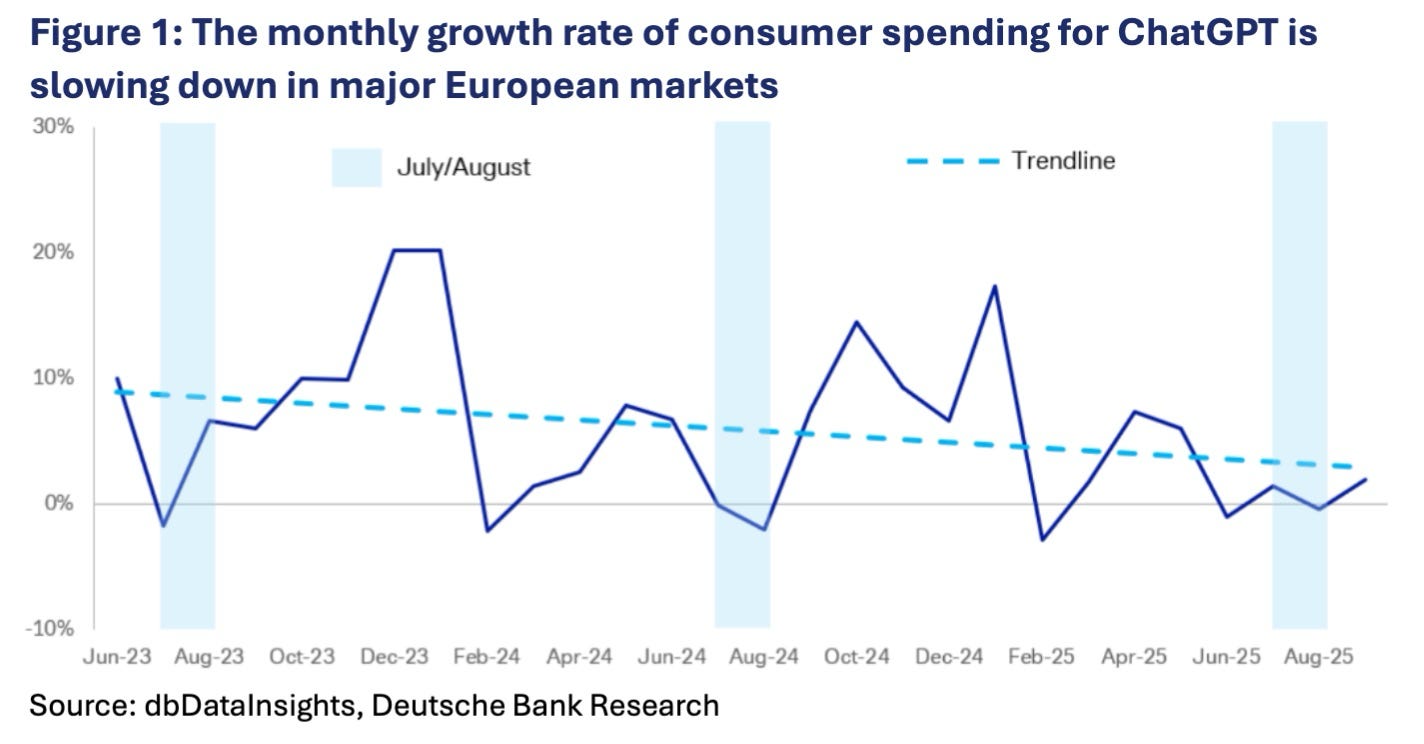
The flagging interest and willingness to spend on AI isn’t lost on industry leaders. They need to win over the public faster to make their circle jerk deals pay off and keep investors pushing up their valuations. So what can they do?
Feed them slop
In what may be the most cynical move by this industry to date, Altman announced on Oct. 14 that the ChatGPT platform would remove guardrails around “erotic” content. So much for cancer breakthroughs.
As a purely business move, going sexy is a best practice. In the age of OnlyFans and PornHub, we’re talking an annual growth rate of 8.6% and revenue of up to $75 billion a year— about 6X what OpenAI is generating now. Solving world hunger? Personalized pornbots have been a dream for a lot of people for a long time—a dream they’re willing to pay for to make a reality.
As a move for public acceptance, allowing erotic content on AI is also deft. Today’s fiercest brand loyalty is for social media and where people get their dopamine. Think about the battle over TikTok. This was a Chinese spying app sucking up info (and probably more) about us. Government officials had to create a deal to save it. Killing TikTok was not an option unless everyone wanted to be voted out of office.
Now, a product promising solutions for all of humanity is giving us NSFW content.
In the long run, it’s a good bet AI is going to deliver on the best of its promises, much in the way the dot-com boom produced beneficial companies and technologies. The problem is that the pace and structure of the financing is pushing these leaders to bad decisions.
The good news for now is that we are still in charge. We still have the financial and regulatory power to make AI a benefit, not a threat. We have a choice to either push these leaders to act with responsibility—for example, making sustainable energy for all of us, not just their ravenous data centers—or let them lure us with AI companions who tell us what we want to hear.
Thanks for this David. Very solid.
My only question: is it fear-mongering to consider another country reaching an advanced level that allows them to infiltrate, access, and manipulate information and intelligence?